
Insulated Power Lines for Wildfire Prevention
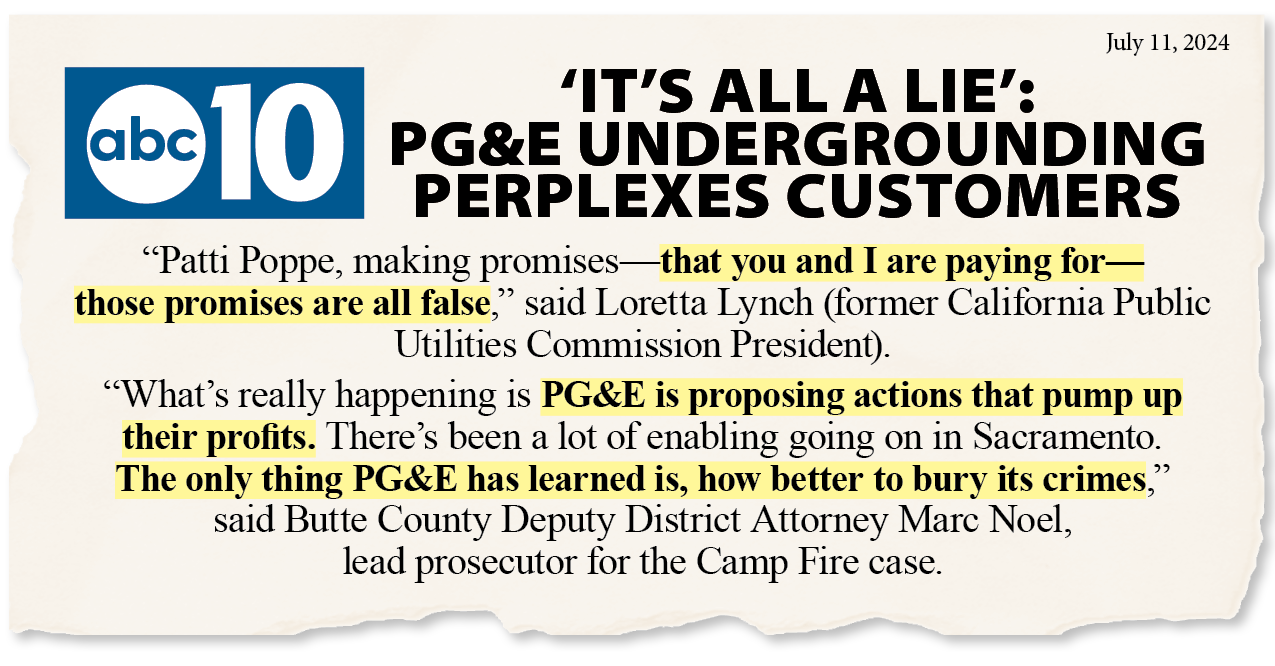

PG&E bills to soar nearly $400/year
in 2024 for millions
of California households
From the San Francisco Chronicle:
The CPUC was considering two internal proposals that both offered less revenue than PG&E had requested, but differed in how much to allow the company to spend installing power lines underground. Ratepayer advocacy groups such as TURN pushed for the commission to promote a far less expensive and faster method by insulating bare wires instead of the laborious process of burying them. The CPUC opted to allow for more buried lines.
“We’re disappointed,” Morsony said. “We need to be choosing only the most affordable and fastest wildfire safety measures to protect customers and their pocketbooks.”
Visit https://www.sfchronicle.com/california/article/pge-rate-hike-18458239.php to read the full article.
CapRadio interview with
TURN Executive Director Mark Toney
PG&E customers will be paying close to $400 more per year for their service due to new rate hikes approved earlier this month by the California Public Utilities Commission. While the rate hikes were not a surprise, they come at a time where customers are dealing with massive cost of living increases. Mark Toney, Executive Director of TURN (The Utility Reform Network), joins us to discuss the impact of the increases especially on lower income, vulnerable Californians.
Note: PG&E’s press release regarding the rate increases can be found here.
Learn about the CPUC’s Two Proposed Decisions in Response to PG&E’s Request for New Safety and Reliability Investments
In PG&E’s initial GRC application, the utility requested many changes it claimed were necessary to ensure the safety and reliability of its energy services. Inflation and a significant investment in undergrounding electric lines ranked among the top cost drivers in PG&E’s request. Over the past year and a half, multiple parties reviewed PG&E’s GRC request and provided input on each cost category and related proposed expenditures.*

*Visit https://www.cpuc.ca.gov/news-and-updates/all-news/cpuc-releases-two-pds-in-response-to-pge-request-for-new-investments-2023 to read the full article.
TURN Newsroom

Source: The Cool Down | By Leslie Satler
To consumer advocates, the change appears tied to mounting frustration over utility prices. Mark Toney, executive director of The Utility Reform Network, said, "I'd say we saw today a lot of evidence that Gov. Newsom has really prioritized affordability and accountability to an increased extent.”
California's soaring electricity bills have made affordability a driving force in energy policy. Gov. Gavin Newsom's latest move is a package of electricity-affordability bills built around home batteries and other smart devices that could help lower and reduce the need for gas-fired backup plants.
Source: Capitol Weekly | By Opinion by Mark Toney, Executive Director of TURN
SB 905 would help ensure utilities don’t get overpaid for work that already benefits the company by requiring the California Public Utilities Commission to examine whether the profit margins utilities earn on wildfire-related spending — like undergrounding power lines — are justified. This work already protects utilities from costly wildfire lawsuits, and that protection shouldn’t come with an extra reward: outsized profit margins billed to customers who are struggling to keep the lights on.
Electricity bills have skyrocketed over the past few years for residential and business customers of Pacific Gas & Electric, SoCal Edison and San Diego Gas & Electric — in large part because of the $40 billion customers have paid to cover California’s wildfire costs.
Source: Canary Media | By Jeff St. John
Google and PG&E have been tussling with the Sierra Club, The Utility Reform Network, and others over how to allocate the cost of connecting that 250-MW “large load” to the utility transmission grid. The big issue? How much of that cost should be borne by PG&E customers at large versus by Google itself.
California has yet to take full advantage of rooftop solar, backup batteries, and other home devices to create virtual power plants (VPPs) that can help its stressed-out grid — even though it has more of those distributed energy resources than any other state. Earlier this month, utility Pacific Gas & Electric launched its latest effort to improve on that poor record via an ambitious partnership with friendly neighborhood tech giant Google and pro-electrification nonprofit Rewiring America.
Source: Canary Media California Wire | By Jeff St. John
In addition, SB 905 would encourage utilities to measure how efficiently they’re using their existing grids — a precursor to setting up regulations that could steer them toward prioritizing lower-cost solutions over expensive grid upgrades. These aren’t the only affordability proposals on the table. The Utility Reform Network has a list of bills awaiting Newsom’s signature that offer even wonkier ways to ride herd on utility costs.
Democratic Gov. Gavin Newsom — who everyone knows is eyeing a run for the White House — has one last chance to show his true colors on energy and climate change. Rising electricity costs are a major issue in California, and Newsom must decide by the end of this month whether to sign a host of bills that could help cut utility rates while also advancing the state’s clean energy transition.
Source: Bakerfield.com | By John Cox
Executive Director Mark Toney of Oakland-based The Utility Reform Network said by email he was encouraged the CPUC’s new chairman, John Reynolds, is looking at potential improvements such as requiring utilities to include more information in their rate-case applications. “TURN is urging the commission to protect ratepayers and hold utilities accountable to spending within their budgets to provide safe, clean, affordable energy by requiring utilities to: Aspire to limit (general rate case) spending to as close to inflation as possible, rein in overspending in accounts outside of the GRC, and auditing actual shareholder returns versus authorized returns,” Toney wrote.
Work began this month on a regulatory process intended to boost affordability, accountability and transparency in the way California’s investor-owned gas and electric utilities apply for permission to raise their rates.
Source: Lifeline with Craig Roberts (podcast) KFAX | By Craig Roberts
This podcast featuring Executive Director of TURN Mark Toney aired September 15th 2026
Craig: I want to get your response to the failure of the California Legislature to pass SB 492 and PG&E’s answer that their financial risk to harden their infrastructure results is way too much for lenders and investors, so they will hold off on that.
Mark: Just because PG&E can’t get what it wants, they can’t just pick up their toys and go home. I told their executives that they need to spend less money burying lines underground (which is extremely expensive and takes an extremely amount of time) and do what Edison has done by insulating overhead power lines. It is just as safe and costs one-fifth, and can be done five times faster than burying the lines.
Craig: why isn’t PG&E insulating the lines and reducing the immediate risk of fires? There is no sense of urgency.
Mark: Shareholder returns. The more money they invest in capital investments, the more they can get in returns. Returns is not the only thing; we need safety. If you don’t have safety, lenders charge a higher interest rate because of the risk, and you and I pay the higher interest rate. What we are saying is reduce the risk as quickly and inexpensively as possible, so we have less of these shutoffs and wildfire disasters.
Mark: Please ask your listeners to call (916) 445 2841; this is the phone number that the Governor’s office has to make public comments on bills. Ask your listeners to call this number and urge him to sign SB 905 and the other six TURN affordability bills. They know what these bills are and we’ve been working with them since January. The Governor’s office needs to know that your listeners come from all over California.
Craig: this is a comment line set up with the Governor’s office and believe it or not, these calls matter. We have learned that each call represents hundreds of people who want to make a difference.
Source: KTVU Fox 2 | By Tom Vacar and Allie Rasmus
Mark Toney, CEO of The Utility Reform Network, known as TURN, a longtime critic of PG&E, was upset. "The legislature adopted nothing," he said. Toney said things TURN wanted were also ignored to keep the California Wildfire Fund able to cover liabilities caused by electric utility equipment. "We need a plan that makes the $40 billon last and doesn't get depleted," he said. "That didn't happen.” TURN's position is that PG&E should live within the money it has and quit the slow, expensive process burying power lines. "At a cost of $4 million a mile and we're gonna replace those with insulating overhead powerlines, insulated poles, at one-fifth of the cost and it can be done much faster," he said.
Pacific Gas and Electric Company announced plans on Wednesday to postpone roughly $2 billion in capital investments next year to bolster its finances, aiming to "reinvent" itself and improve its financial outlook. The reduction in capital spending could impact project timelines for connecting new homes, establishing data centers, and implementing clean energy initiatives.
Source: ABC7 News | By Dryden Quigley
The Utility Reform Network, a consumer advocacy group, said it supports the measure. "We need a way to basically penalize the utility executives for starting wildfires. And that's never happened before," said Lee Trotman with The Utility Reform Network. The organization said it supports the bill in its entirety, arguing that it protects ratepayers while prioritizing wildfire survivors through a faster payout process. "There's no way you can compensate someone for the loss of life, right? Their families, etc.. but you make it financially painful. You make sure that the utility executives have skin in the game," Trotman said.
California lawmakers are a step closer to an agreement on who should be held responsible when a utility causes a wildfire, after the Governor, Senate and Assembly leaders reached a compromise reflected in Senate Bill 492. According to the California Public Utilities Commission, utilities have caused roughly half of the state's most destructive wildfires.
Source: California Senate Democratic Caucus | By EIN Presswire
“TURN is very pleased to see SB 327 make it to the governor’s desk. Preventing utilities from using ratepayer money to stop municipalization and protecting the Public Advocates Office’s right to investigate utilities for compliance with the law is more important now than ever before. At a time of skyrocketing utility bills, people deserve to choose a lower cost option like a municipal utility,” said Adria Tinnin, director of Race Equity and Legislative Policy for TURN. “We thank Sen. McNerney for this important legislation and urge Governor Newsom to stand with California families and businesses and sign SB 327 into law.”
The California Legislature today approved Sen. Jerry McNerney’s SB 327, which would protect ratepayers by strengthening oversight of investor-owned utilities (IOUs) and barring IOUs from using ratepayer funds to fight local efforts to create municipal utilities.
Source: The Sacramento Bee | By Andrew Graham and Stephen Hobbs
Newsom is not alone in his stance, including from people who are not traditionally aligned with utility companies. Mark Toney, executive director of The Utility Reform Network, an organization that works to protect ratepayers from increased electrical rates, backs the idea of eliminating the ability of insurance companies to recoup money. He sees it as a way to help sustain a state wildfire fund and prevent taxpayers from being asked to keep refilling it.
Gov. Gavin Newsom’s last ditch effort to pressure legislators to change the way the state handles utility-caused wildfires involves an array of measures. But one issue in particular has become a flashpoint in the ongoing negotiations: Whether insurance companies should be able to recoup money from a utility company after a fire.
Source: CBS News | By Steve Large
Mark Toney, executive director of The Utility Reform Network, said lawmakers need to move quickly. "We are in a race with time," Toney said. "We need to cut out third parties, insurance companies. We need to limit attorneys' fees.”
California lawmakers and Gov. Gavin Newsom are racing to reach a deal on changes to the state's wildfire liability system, with just days remaining before the legislative session ends. The proposed reforms could affect how wildfire victims are compensated and how much utilities such as PG&E are responsible for paying after fires linked to their equipment.
Source: FOX 2 KTVU | By Tom Vacar
"The decision that the CPUC is about to make, PG&E could raise your monthly bill $50 or more a month," said Mark Toney, the executive director of The Utility Reform Network (TURN). Over the lifetime of the decision — up to 20 years — TURN calculates that each customer's portion could be around $18,000.
The California Public Utilities Commission (CPUC) plans to unveil a proposed decision concerning PG&E's requested rate hikes. The utility company says the increases are crucial as it aims to bury 10,000 miles of power lines as a preventative measure against wildfires in high-risk regions. This increase is substantial.
Source: SF Gate | By Anabel Sosa
Mark Toney, the executive director of the Utility Reform Network, a nonprofit legal advocacy network, told SFGATE in an email that there are still questions about the specifics of Becerra’s plan but that it is “encouraging” to see the candidate’s commitment to bringing down the price of electricity. “While we are unsure how much ratepayers might benefit from two free hours of electricity, we are eager to learn more about the proposal,” Toney said.
During midday in California, the state’s solar grid produces so much energy that, sometimes, it can’t even use it all. It’s a good problem to have, and one that the leading Democratic candidate governor thinks could be a boon to low-income households. At a recent summit hosted by Politico, Xavier Becerra said he wants to offer free electricity from 1 p.m. to 3 p.m. for those who qualify, possibly saving them upward of $1,000 annually.
Source: San Francisco Chronicle | By Jessica Roy
California has the second-highest electricity costs of any state in the U.S. Mark Toney, the executive director of nonprofit consumer advocacy group The Utility Reform Network, said high rates and fluctuating weather patterns can make monthly bills unpredictable. Electricity bills “have high volatility,” he said. “They can go up very quickly, before you know it, based on the weather that you really have very little control over.”
If you or another full-time resident in your home relies on energy for a medical need — for instance, if you use a respirator, oxygen generator, powered wheelchair, dialysis machine or apnea monitor, or if you need a refrigerator to keep medicine such as insulin cold, or depend on heating or cooling for conditions like multiple sclerosis or scleroderma — you are eligible to receive an extra monthly allotment of energy at the lower baseline price. Eligibility is based on medical need, not income.
Source: San Francisco Chronicle | By Mark Toney, Executive Director of TURN (contributor)
PG&E is seeking to charge California ratepayers billions for outstanding costs, which will soon show up on our electricity bills. The utility has also requested and is expected to collect on several additional pending proposals to raise rates over the coming years and has $1.05 billion sitting in memorandum accounts that will be billed to ratepayers. This includes billions of dollars for wildfire mitigation, grid upgrades and other investments — as well as the hefty profit margins the utility is allowed to collect.
PG&E claims its rates are stabilizing. The numbers say otherwise. According to an independent assessment by the California Public Utilities Commission’s Public Advocates Office, the state’s advocate for ratepayers, the average PG&E customer could pay $840 more annually by 2030, on top of the 69% rate increase during the past decade.
Source: Benton Institute for Broadband and Society | By Kevin Taglang
During the 2026 proceeding, AARP and TURN argued that the telephone remains a preferred channel for older adults, lower-income households, and consumers with limited digital literacy—and, as TURN noted, for people who do not yet have broadband and are calling to find out what it costs. TURN cited 2023 American Community Survey data showing that "80 percent of adults with vision difficulty own a smartphone, against 62.7 percent with home broadband service."
If you shop for home internet service in the coming months, something on the screen may look different. For the past two years, providers have had to show you a standardized "broadband label"—a black-and-white box modeled on the nutrition panel on a cereal box, listing the monthly price, what happens when the introductory rate expires, the typical speeds, the latency, the data allowance, and each fee added on top. The label had to sit right next to the advertised plan.
Source: The Hemet and San Jancinto Chronicle | By HSJC Newsroom
In a unanimous 4-0 vote Thursday, commissioners rejected the utilities’ plan, saying it failed to provide “sufficient health protections for customers.” The panel had originally set May 1 as the deadline for new rules to take effect. When utilities missed that deadline, consumer advocates filed emergency motions demanding action. By May, with utilities still lagging, The Utility Reform Network joined forces with the San Diego-based Utility Consumers’ Action Network, the National Consumer Law Center and the Center for Accessible Technology to formally ask the commission to step in.
California utility regulators have moved to strengthen protections for customers facing power shutoffs during dangerous heat waves, ruling this week that major electric companies failed to deliver on requirements to better shield vulnerable residents from disconnection when temperatures soar. The decision comes as another punishing heat wave grips much of the state, underscoring the real-world stakes of the debate. In rural areas, losing electricity can also mean losing access to water, since many wells rely on electric pumps. In cities, going without air conditioning or fans during a prolonged hot spell can pose serious health risks, and in extreme cases, prove fatal.
Source: CalMatters | By Alejandro Lazo
By May, with utilities still behind schedule, The Utility Reform Network joined with the San Diego-based Utility Consumers’ Action Network, the National Consumer Law Center and the Center for Accessible Technology,asking the commission to intervene. This week the commission rejected the utilities’ proposal, siding with advocates. The path the utilities were proposing would be “no different” than prior practice. The resolution noted the extreme heat threshold is already below 100 degrees in 41 of California’s 58 counties.
California bars utilities from cutting off power to customers who fall behind on their bills when it’s dangerously hot outside – a basic safety protection. Losing power in some rural areas can also mean losing water, and in cities, having no way to cool down can be dangerous, even deadly, when hot weather spans several days.
Source: Sierra Sun Times | By Gerd Altman
“Extreme heat and utility disconnections are a dangerous combination that can put lives at risk. Today's decision recognizes that access to electricity is essential for health and safety during increasingly frequent heat events,” said Lee Trotman, communications director at The Utility Reform Network (TURN). “By requiring utilities to use CalHeatScore and lowering the temperature threshold for disconnection protections, the CPUC has taken an important step to better protect Californians — especially seniors, families with young children, people with disabilities, and low-income households — from losing power when they need it most.”
The California Public Utilities Commission on Thursday unanimously agreed to reduce the temperature that triggers a statewide ban on utility disconnections to 90 degrees Fahrenheit, rejecting corporate utilities’ proposal to keep the threshold at 100 degrees.
Source: KCBX | By Kendra Hanna
Matt Freedman, an attorney with The Utility Reform Network, agreed with the decision to source the funding from “volumetric performance fees” — money that PG&E already collects from ratepayers. “Any additional payments to the local governments should be taken out of the existing incentives and slush funds that PG&E collects in rates already, rather than raising rates further to cover this cost,” Freedman told KCBX.
A state bill that would renew payments made by PG&E to San Luis Obispo County schools and other agencies has been altered to draw from a new funding source. Senate Bill 931 was amended last month while in the Assembly Utilities and Energy Committee.
Press Releases

SAN FRANCISCO— The California Public Utilities Commission today agreed to reduce the temperature that triggers a statewide ban on utility disconnections to 90 degrees Fahrenheit, rejecting corporate utilities’ proposal to keep the threshold at 100 degrees.
Oakland, CA - Today, The Utility Reform Network (TURN) has filed a motion to intervene in AT&T’s federal lawsuit against the California Public Utilities Commission and California Attorney General. TURN submitted this filing in partnership with the California State Association of Counties (CSAC), Rural County Representatives of California (RCRC), and the Communications Workers of America (CWA).
SACRAMENTO – Yesterday, Senator Steve Padilla (D-San Diego) introduced Senate Bills 886and 887, two measures designed to protect California ratepayers from the potential increased costs and environmental damage caused by data centers.
Oakland, CA — The Utility Reform Network (TURN) is calling on PG&E customers to raise their voices against PG&E’s proposed rate increases, which could drive monthly bills up by $42—totaling more than $500 annually—by 2030…
Sacramento, CA — California utility consumers are demanding lawmakers rein in skyrocketing rates and hold for-profit investor-owned utilities (IOUs) accountable…
Coalition applauds Senate’s SB 254 release; calls for swift passage alongside CAP’s affordability measures for both immediate relief and long‑term savings…
Los Angeles, CA — Southern California Edison (SCE) reported a record $1.619 billion in 2024 profits today, a 9.8% increase from the previous year. While profits increased, SCE customer’s rates have increased by 26% in the last three years…
San Diego, CA — San Diego Gas & Electric today reported near record profits of $891 million off the backs of customers. SDG&E’s earnings report follows over $1.6 million spent in 2024 by its parent company…
SAN FRANCISCO — Pacific Gas & Electric (PG&E) today reported a 10% increase in profits from 2023 to 2024, totaling $2.48 billion dollars.
Sacramento, Calif. — California’s four major investor-owned utilities (IOUs) — for-profit corporate utilities — spent a staggering $21,854,420 on lobbying and influence efforts in 2024.
Sacramento, CA — The Utility Reform Network (TURN) released their 2024 Legislative Affordability and Accountability Scorecard today, evaluating lawmakers’ commitment to utility affordability and accountability during the 2024 legislative session.
Oakland, CA – TURN proudly announces a significant win for California ratepayers! The California Public Utilities Commission (CPUC) has issued a decision that will reduce shareholder profits for the state’s largest energy utilities, including PG&E, SCE, SoCalGas, and SDG&E.
SACRAMENTO, Calif. — California voters want policy leaders to take decisive action to address the root causes of high electricity bills, including limiting how much utilities can spend and profit, according to a poll conducted by David Binder Research...
On February 1, the California Public Utilities Commission issued a proposed decision to authorize early collection of $516 million from PG&E customers for wildfire safety, and other infrastructure upgrades, conducted in 2022…
Today, Senator Dave Min (D-Irvine) introduced Senate Bill (SB) 938, which will prohibit political lobbying by investor-owned utilities that can be charged to ratepayers. While federal law technically prohibits utilities from passing lobbying costs onto their ratepayers…
When you think about what you’re paying for in your electric and gas utility bill, you probably think of the energy powering your lights, furnace, and stove…
On December 1, PG&E submitted a CPUC filing requesting its customers to pay an additional $2 billion in rate increases to cover wildfire mitigations costs, barely two weeks after approval of record breaking increases for its General Rate Increase.
On November 7, PG&E executives scheduled a private meeting met with Commission staff to lobby for an additional $1.8 billion in ratepayer increases in the Alternative Proposed Decision, which had already been modified in PG&E’s favor.
Yesterday, the California Public Utilities Commission (CPUC) voted unanimously to consider proposals to improve service quality requirements for telephone service, and expand service quality requirements to cover Voice over Internet Protocol (VoIP) phone…