

SEMPRA General Rate Case
SPEAK UP NOW!
Share Your Story...
stand up and fight for people over profits.
If SoCalGas gets their way, your annual
base utility bill will increase by another $68 in 2028 & $244 in 2031!*
*Increases amounts are averages.
IN-PERSON MEETING DETAILS
Date: November 9, 2026
Times: 2:00pm & 6:00 pm
SoCalGas – El Monte City Hall
East Council Chambers
11333 Valley Blvd., El Monte, CA 91731
}
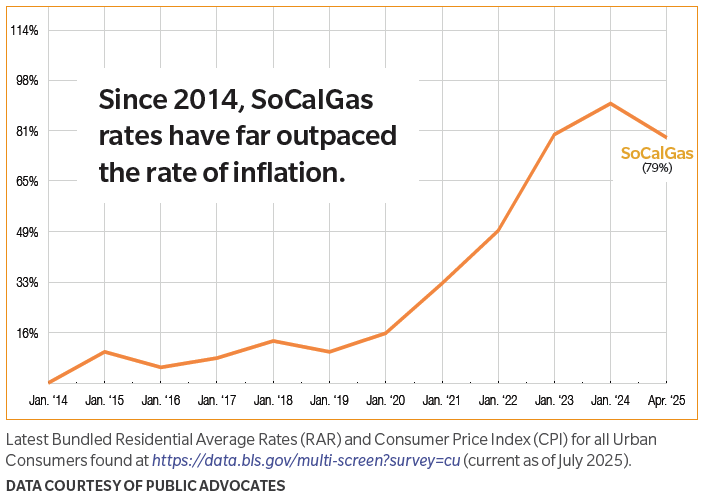
“SoCalGas... hitting us with increasing charges... Most can’t afford the utility’s service, especially when it is cold. No on this proposal!”
“When will it stop! They are making it impossible for the average person to even afford the basics.”
If SDG&E gets their way, your annual
base utility bill will increase by another $273 in 2028 & $994 in 2031!*
*Increases amounts are averages.
IN-PERSON MEETING DETAILS
Date: November 10, 2026
Times: 2:00pm & 6:00 pm
}
SDG&E - Santee City Hall
10601 Magnolia Avenue Building 2
Santee, CA 92071
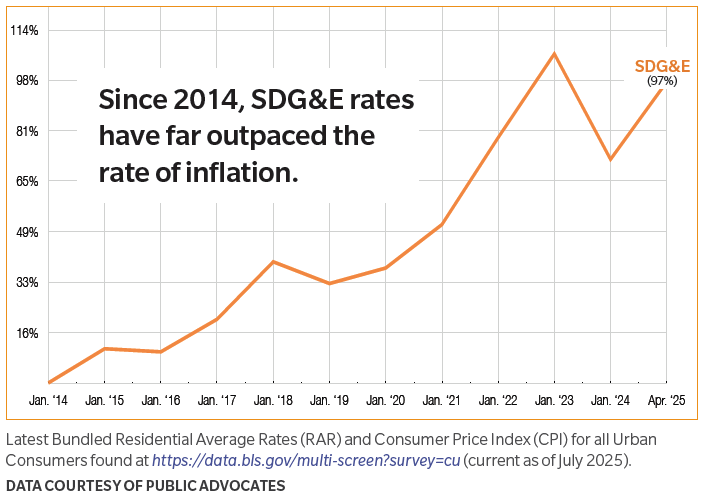
“Are you serious? We are a small non-profit, barely making it!”
“SDG&E already has the most egregiously expensive utility rates in this country.”
Learn why my energy bills are so high here.
Speak at a Public Forum!
2. Remote Public Hearings Virtual PPH participants who want to comment in ASL need to contact the Public Advisor's Office (public.advisor@cpuc.ca.gov) at least five business days before the PPH they plan to attend. (ASL interpreters will be present at the in-person PPHs).
December 9, 2026 / 2pm & 6pm
Phone Number: 1-800-857-1917
Passcode: 1673482#
Webcast: www.adminmonitor.com/ca/cpuc/December 10, 2026 / 2pm & 6pm
Phone Number: 1-800-857-1917
Passcode: 1673482#
Webcast: www.adminmonitor.com/ca/cpuc/
If you wish to make a public comment, please participate by phone using the phone number below, press *1, unmute your phone, and provide your name when prompted.
Please see the schedule and location information below.
1. In-Person Public Hearings
To request accommodations or interpretation in a language other
than American Sign Language (ASL), commenters need to contact
the Public Advisor's Office (public.advisor@cpuc.ca.gov)
at least five business days before the PPH they plan to attend.
November 9, 2026 / 2pm & 6pm
SoCalGas: El Monte City Hall East Council Chambers
11333 Valley Blvd., El Monte, CA 91731November 10, 2026 / 2pm & 6pm
SDG&E: Santee City Hall
10601 Magnolia Avenue, Building 2
Santee, CA 92071
TURN Newsroom

Source: New York Post | By Maria Pena
“Community solar and storage is a way to increase clean energy generation, and so that would be an example, a very specific example, of something the state could do,” Toney said. A major factor during heat waves is solar power, which not only provides electricity during the day but helps charge batteries that can supply power later, Toney explained.
Gov. Gavin Newsom vetoed AB 1813 on Sept. 30, legislation authored by Assemblymember Christopher Ward that would have created a customer renewable energy subscription program aimed at expanding access to community renewable energy projects. The Utility Reform Network supported the legislation.
Source: The Institute for Energy Research |
According to Mark Toney, Executive Director of the Utility Reform Network, a ratepayer advocacy group, “Collectively these measures protect ratepayers from subsidizing the significant energy consumption of data centers, ensuring that the data centers pay upfront for the extra infrastructure that must be built to operate them, and pay their fair share for wildfire mitigation and other ratepayer-funded programs.”
On September 21, Governor Gavin Newsom signed seven bills regulating the data center industry in California, imposing new requirements on electricity costs, water use, and local oversight. The legislation requires data centers to provide information on electricity use, water consumption, land use, and workforce needs, giving local communities more information to assess proposed projects.
Source: Communications Daily | By Philip Athey
However, the Utility Reform Network (TURN) urged the CPUC to reject NaLA’s proposal to allow providers to set prices because it “would essentially guarantee that the [specific support amount] would be locked at the highest amount the Commission allows, regardless of the competitiveness of providers’ offerings.”
Industry commenters said a proposed update to California Lifeline’s minimum-service standards and subsidy levels would pose logistical challenges for service providers that could push them out of the program if the California Public Utilities Commission (CPUC) adopts the plan without any changes.
Source: Canary Media | By Jeff St. John
Newsom’s move drew praise from consumer advocates, clean energy trade groups, and environmental organizations. “I’d say we saw today a lot of evidence that Gov. Newsom has really prioritized affordability and accountability to an increased extent,” said Mark Toney, executive director of The Utility Reform Network, a ratepayer advocacy group that sponsored seven bills this legislative session, all of which were passed into law.
California Gov. Gavin Newsom (D) defied political expectations on Wednesday and signed into law a slate of energy-affordability legislation aimed at containing the utility spending that is driving up electricity costs in the Golden State.
Source: Communications Daily | By Philip Athey
The Utility Reform Network said the monitoring period in the proposal is too long and could subject California Lifeline customers to two years of price increases before a higher subsidy level is introduced. The group instead recommended an eight-month monitoring period with an updated subsidy level presented in 12 months.
Nearly all industry and public advocacy organizations said they support a proposed decision from the California Public Utilities Commission (CPUC) to increase the subsidy level and minimum service requirements for the state's Lifeline program, suggesting only minor changes and clarifications. But one, Assurance Wireless, said the changes in the proposal were so significant that they potentially overstep the CPUC’s legislative mandate and raise the question of federal preemption.
Source: Canary Media California Wire | By Jeff St. John
In addition, SB 905 would encourage utilities to measure how efficiently they’re using their existing grids — a precursor to setting up regulations that could steer them toward prioritizing lower-cost solutions over expensive grid upgrades. These aren’t the only affordability proposals on the table. The Utility Reform Network has a list of bills awaiting Newsom’s signature that offer even wonkier ways to ride herd on utility costs.
Democratic Gov. Gavin Newsom — who everyone knows is eyeing a run for the White House — has one last chance to show his true colors on energy and climate change. Rising electricity costs are a major issue in California, and Newsom must decide by the end of this month whether to sign a host of bills that could help cut utility rates while also advancing the state’s clean energy transition.
Source: Bakerfield.com | By John Cox
Executive Director Mark Toney of Oakland-based The Utility Reform Network said by email he was encouraged the CPUC’s new chairman, John Reynolds, is looking at potential improvements such as requiring utilities to include more information in their rate-case applications. “TURN is urging the commission to protect ratepayers and hold utilities accountable to spending within their budgets to provide safe, clean, affordable energy by requiring utilities to: Aspire to limit (general rate case) spending to as close to inflation as possible, rein in overspending in accounts outside of the GRC, and auditing actual shareholder returns versus authorized returns,” Toney wrote.
Work began this month on a regulatory process intended to boost affordability, accountability and transparency in the way California’s investor-owned gas and electric utilities apply for permission to raise their rates.
Source: California Senate Democratic Caucus | By EIN Presswire
“TURN is very pleased to see SB 327 make it to the governor’s desk. Preventing utilities from using ratepayer money to stop municipalization and protecting the Public Advocates Office’s right to investigate utilities for compliance with the law is more important now than ever before. At a time of skyrocketing utility bills, people deserve to choose a lower cost option like a municipal utility,” said Adria Tinnin, director of Race Equity and Legislative Policy for TURN. “We thank Sen. McNerney for this important legislation and urge Governor Newsom to stand with California families and businesses and sign SB 327 into law.”
The California Legislature today approved Sen. Jerry McNerney’s SB 327, which would protect ratepayers by strengthening oversight of investor-owned utilities (IOUs) and barring IOUs from using ratepayer funds to fight local efforts to create municipal utilities.
Source: FOX 2 KTVU | By Tom Vacar
"The decision that the CPUC is about to make, PG&E could raise your monthly bill $50 or more a month," said Mark Toney, the executive director of The Utility Reform Network (TURN). Over the lifetime of the decision — up to 20 years — TURN calculates that each customer's portion could be around $18,000.
The California Public Utilities Commission (CPUC) plans to unveil a proposed decision concerning PG&E's requested rate hikes. The utility company says the increases are crucial as it aims to bury 10,000 miles of power lines as a preventative measure against wildfires in high-risk regions. This increase is substantial.
Source: SF Gate | By Anabel Sosa
Mark Toney, the executive director of the Utility Reform Network, a nonprofit legal advocacy network, told SFGATE in an email that there are still questions about the specifics of Becerra’s plan but that it is “encouraging” to see the candidate’s commitment to bringing down the price of electricity. “While we are unsure how much ratepayers might benefit from two free hours of electricity, we are eager to learn more about the proposal,” Toney said.
During midday in California, the state’s solar grid produces so much energy that, sometimes, it can’t even use it all. It’s a good problem to have, and one that the leading Democratic candidate governor thinks could be a boon to low-income households. At a recent summit hosted by Politico, Xavier Becerra said he wants to offer free electricity from 1 p.m. to 3 p.m. for those who qualify, possibly saving them upward of $1,000 annually.
Source: Canary Media | By Jeff St. John
SB 905 represents an important, if somewhat incremental, next step on those efforts, said Matthew Freedman, senior staff attorney at The Utility Reform Network (TURN), one of the state’s most vocal utility ratepayer advocacy groups and a sponsor of the bill. Among the bill’s provisions, a “lower return on equity is a pretty big one,” he said. Utilities earn guaranteed rates of profit on capital investments, which puts upward pressure on customer rates. Anything that can reduce that rate of “return on equity,” or ROE, could help limit those increases, he said. A number of states are targeting utilities’ ROE to combat rising rates — and utilities are, not surprisingly, fighting back against the idea.
California lawmakers are once again contending with how to curb the state’s high energy costs as they hurtle toward the end of this year’s legislative session on Aug. 31. So what’s on the table for utility rate reform in the final stretch? Enter Senate Bill 905, a complicated package of proposals that are likely to face intense opposition from utilities, which tend to reflexively resist rules that could crimp their profits.
Source: Yahoo!Finance | By Kim LaCapria
Mark Toney, executive director of nonprofit consumer advocacy group The Utility Reform Network, described electricity bills as having "high volatility," according to the newspaper.
Forecasters expected the Central Valley to get close to 110 degrees and parts of the Bay Area to climb into the low 100s. In a state that already has some of the highest electricity prices in the country, that kind of heat can make air conditioning a major financial burden for families trying to stay safe.
Source: San Francisco Chronicle | By Jessica Roy
California has the second-highest electricity costs of any state in the U.S. Mark Toney, the executive director of nonprofit consumer advocacy group The Utility Reform Network, said high rates and fluctuating weather patterns can make monthly bills unpredictable. Electricity bills “have high volatility,” he said. “They can go up very quickly, before you know it, based on the weather that you really have very little control over.”
If you or another full-time resident in your home relies on energy for a medical need — for instance, if you use a respirator, oxygen generator, powered wheelchair, dialysis machine or apnea monitor, or if you need a refrigerator to keep medicine such as insulin cold, or depend on heating or cooling for conditions like multiple sclerosis or scleroderma — you are eligible to receive an extra monthly allotment of energy at the lower baseline price. Eligibility is based on medical need, not income.
Source: San Francisco Chronicle | By Mark Toney, Executive Director of TURN (contributor)
PG&E is seeking to charge California ratepayers billions for outstanding costs, which will soon show up on our electricity bills. The utility has also requested and is expected to collect on several additional pending proposals to raise rates over the coming years and has $1.05 billion sitting in memorandum accounts that will be billed to ratepayers. This includes billions of dollars for wildfire mitigation, grid upgrades and other investments — as well as the hefty profit margins the utility is allowed to collect.
PG&E claims its rates are stabilizing. The numbers say otherwise. According to an independent assessment by the California Public Utilities Commission’s Public Advocates Office, the state’s advocate for ratepayers, the average PG&E customer could pay $840 more annually by 2030, on top of the 69% rate increase during the past decade.
Source: Benton Institute for Broadband and Society | By Kevin Taglang
During the 2026 proceeding, AARP and TURN argued that the telephone remains a preferred channel for older adults, lower-income households, and consumers with limited digital literacy—and, as TURN noted, for people who do not yet have broadband and are calling to find out what it costs. TURN cited 2023 American Community Survey data showing that "80 percent of adults with vision difficulty own a smartphone, against 62.7 percent with home broadband service."
If you shop for home internet service in the coming months, something on the screen may look different. For the past two years, providers have had to show you a standardized "broadband label"—a black-and-white box modeled on the nutrition panel on a cereal box, listing the monthly price, what happens when the introductory rate expires, the typical speeds, the latency, the data allowance, and each fee added on top. The label had to sit right next to the advertised plan.
Source: Communications Daily | By Philip Athey
But multiple consumer advocacy groups said this week that the argument was flawed and that discontinuing copper networks in California without CPUC approval poses a severe safety risk. The Utility Reform Network (TURN) said the CPUC should bear in mind that the FCC order is the subject of two federal lawsuits. “The Commission cannot ‘harmonize’ current or proposed COLR rules with an FCC Order that is not settled, but TURN does not object to provisions that contemplate revisiting the rules in the future, if necessary,” the group said. “The nature of these cases and their asks to determine whether the Commission has gone far enough leaves the finality of the FCC’s interpretation of the Network Modernization Order uncertain.”
Advocacy groups are calling on the California Public Utilities Commission (CPUC) to reject industry arguments and instead fight against FCC's preemption of the state’s carrier of last resort rules, according to comment filings Thursday.
Source: The Orange County Register | By Teri Sforza
“What we have to do is to fix the broken system where there are no limits to rate hikes, no limit to how much they can ask for or how many times a year they can ask, and no limit to how much the CPUC can grant,” said Mark Toney, executive director of The Utility Reform Network, at a cyber town hall last week.
Jaw Drop Detail No. 1: California’s big electric companies spent more than one thousand dollars for every state resident on wildfire-related costs between 2019 and 2024. Which is to say, a cool $40 billion, divvied up between post-catastrophe liabilities ($13.6 billion) and pre-catastrophe infrastructure hardening ($26.6 billion).
Source: The San Diego Union-Tribune | By Rob Nikolewski
“There is an affordability issue with any type of rate increases year over year, and we want to see rates decrease significantly instead of going up constantly,” the group’s communications director, Lee Trotman, said in an email to the Union-Tribune. “The way to do that is to call your legislators and demand action and accountability from the CPUC to stop rubber stamping approvals.”
San Diego Gas & Electric officials late Monday afternoon filed a rate request with the California Public Utilities Commission that seeks to increase average monthly bills in 2028 for residential customers using electricity and natural gas by 8.6%. In its filing, SDG&E officials seek an estimated revenue requirement of about $3.8 billion for 2028 — $2.9 billion for electric operations and $900 million for natural gas operations. That’s an increase of $280 million, or 8.1%, compared to estimated levels for 2027.
Source: San Diego Tribune | By Rob Nikolewski
“By taking away telecommunications, you disrupt the foundation of all of that regulatory structure,” said Adria Tinnin, director of race equity and legislative policy, at The Utility Reform Network, commonly known as TURN, a consumer group based in Oakland.
A proposal by Assemblymember Tasha Boerner that would make major changes to the California Public Utilities Commission by amending the state’s constitution has been put on hold by the Encinitas Democrat. Her legislation, called Assembly Constitutional Amendment 9, drew attention for its provision that would expand the number of voting members on the commission from five to nine. The proposal also calls for the CPUC to expressly consider affordability when making decisions on utility rates.
Source: Communications Daily | By Philip Athey
Adria Tinnin, director of race equity and legislative policy at The Utility Reform Network (TURN), said the lack of formal opposition was just a logistics issue. “We didn't expect it to survive, and so we need to prioritize our limited resources on other pieces of legislation, but we're definitely very concerned about deleting the reference to telecom from the state constitution,” she said. “It’s an important Jenga piece.” While the amendment would remove telecom as a constitutionally defined public utility, it wouldn't change the state’s Public Utilities Code. It also wouldn't on its own remove telecom and broadband from the California Public Utilities Commission's (CPUC) portfolio. It would instead direct the California legislature to create a new broadband agency that could take over telecom regulation if a future legislature chose.
Experts and advocacy groups are warning that California’s ACA-9, a proposed amendment that would remove telecom as a constitutionally defined public utility, could weaken regulation of the industry in the state. The constitutional amendment easily passed in the California Assembly last month on a 67-1 vote (see 2605200033). It had previously advanced out of two committees with unanimous votes and without any formal opposition from outside groups, according to an analysis filed with the amendment.
Press Releases

SAN FRANCISCO— The California Public Utilities Commission today agreed to reduce the temperature that triggers a statewide ban on utility disconnections to 90 degrees Fahrenheit, rejecting corporate utilities’ proposal to keep the threshold at 100 degrees.
Oakland, CA - Today, The Utility Reform Network (TURN) has filed a motion to intervene in AT&T’s federal lawsuit against the California Public Utilities Commission and California Attorney General. TURN submitted this filing in partnership with the California State Association of Counties (CSAC), Rural County Representatives of California (RCRC), and the Communications Workers of America (CWA).
SACRAMENTO – Yesterday, Senator Steve Padilla (D-San Diego) introduced Senate Bills 886and 887, two measures designed to protect California ratepayers from the potential increased costs and environmental damage caused by data centers.
Oakland, CA — The Utility Reform Network (TURN) is calling on PG&E customers to raise their voices against PG&E’s proposed rate increases, which could drive monthly bills up by $42—totaling more than $500 annually—by 2030…
Sacramento, CA — California utility consumers are demanding lawmakers rein in skyrocketing rates and hold for-profit investor-owned utilities (IOUs) accountable…
Coalition applauds Senate’s SB 254 release; calls for swift passage alongside CAP’s affordability measures for both immediate relief and long‑term savings…
Los Angeles, CA — Southern California Edison (SCE) reported a record $1.619 billion in 2024 profits today, a 9.8% increase from the previous year. While profits increased, SCE customer’s rates have increased by 26% in the last three years…
San Diego, CA — San Diego Gas & Electric today reported near record profits of $891 million off the backs of customers. SDG&E’s earnings report follows over $1.6 million spent in 2024 by its parent company…
SAN FRANCISCO — Pacific Gas & Electric (PG&E) today reported a 10% increase in profits from 2023 to 2024, totaling $2.48 billion dollars.
Sacramento, Calif. — California’s four major investor-owned utilities (IOUs) — for-profit corporate utilities — spent a staggering $21,854,420 on lobbying and influence efforts in 2024.
Sacramento, CA — The Utility Reform Network (TURN) released their 2024 Legislative Affordability and Accountability Scorecard today, evaluating lawmakers’ commitment to utility affordability and accountability during the 2024 legislative session.
Oakland, CA – TURN proudly announces a significant win for California ratepayers! The California Public Utilities Commission (CPUC) has issued a decision that will reduce shareholder profits for the state’s largest energy utilities, including PG&E, SCE, SoCalGas, and SDG&E.
SACRAMENTO, Calif. — California voters want policy leaders to take decisive action to address the root causes of high electricity bills, including limiting how much utilities can spend and profit, according to a poll conducted by David Binder Research...
On February 1, the California Public Utilities Commission issued a proposed decision to authorize early collection of $516 million from PG&E customers for wildfire safety, and other infrastructure upgrades, conducted in 2022…
Today, Senator Dave Min (D-Irvine) introduced Senate Bill (SB) 938, which will prohibit political lobbying by investor-owned utilities that can be charged to ratepayers. While federal law technically prohibits utilities from passing lobbying costs onto their ratepayers…
When you think about what you’re paying for in your electric and gas utility bill, you probably think of the energy powering your lights, furnace, and stove…
On December 1, PG&E submitted a CPUC filing requesting its customers to pay an additional $2 billion in rate increases to cover wildfire mitigations costs, barely two weeks after approval of record breaking increases for its General Rate Increase.
On November 7, PG&E executives scheduled a private meeting met with Commission staff to lobby for an additional $1.8 billion in ratepayer increases in the Alternative Proposed Decision, which had already been modified in PG&E’s favor.
$10 billion in undergrounding increases proposed GRC capital spending by 24%, from $31 billion to $38 billion*
PG&E reduced other capital spending by $3 billion due to undergrounding, resulting in a net increase of $7 billion in capital…