

No on AB 2797 - Protect Emergency Phone Communications
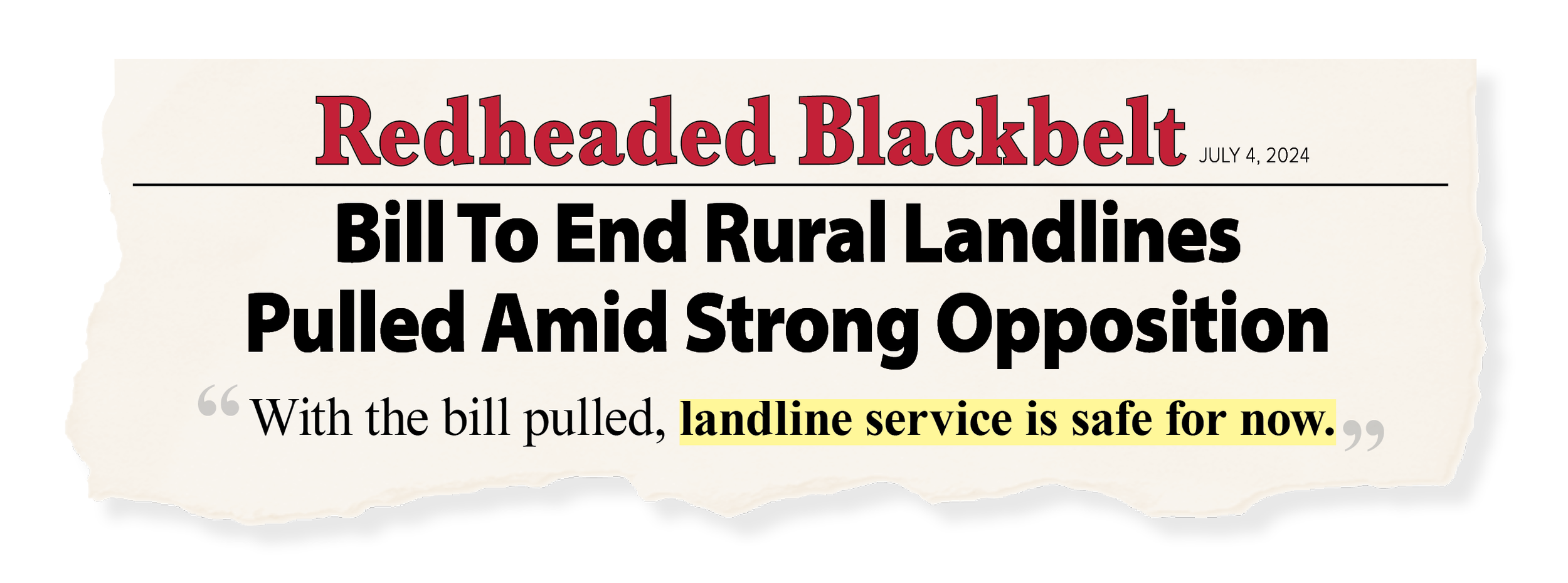
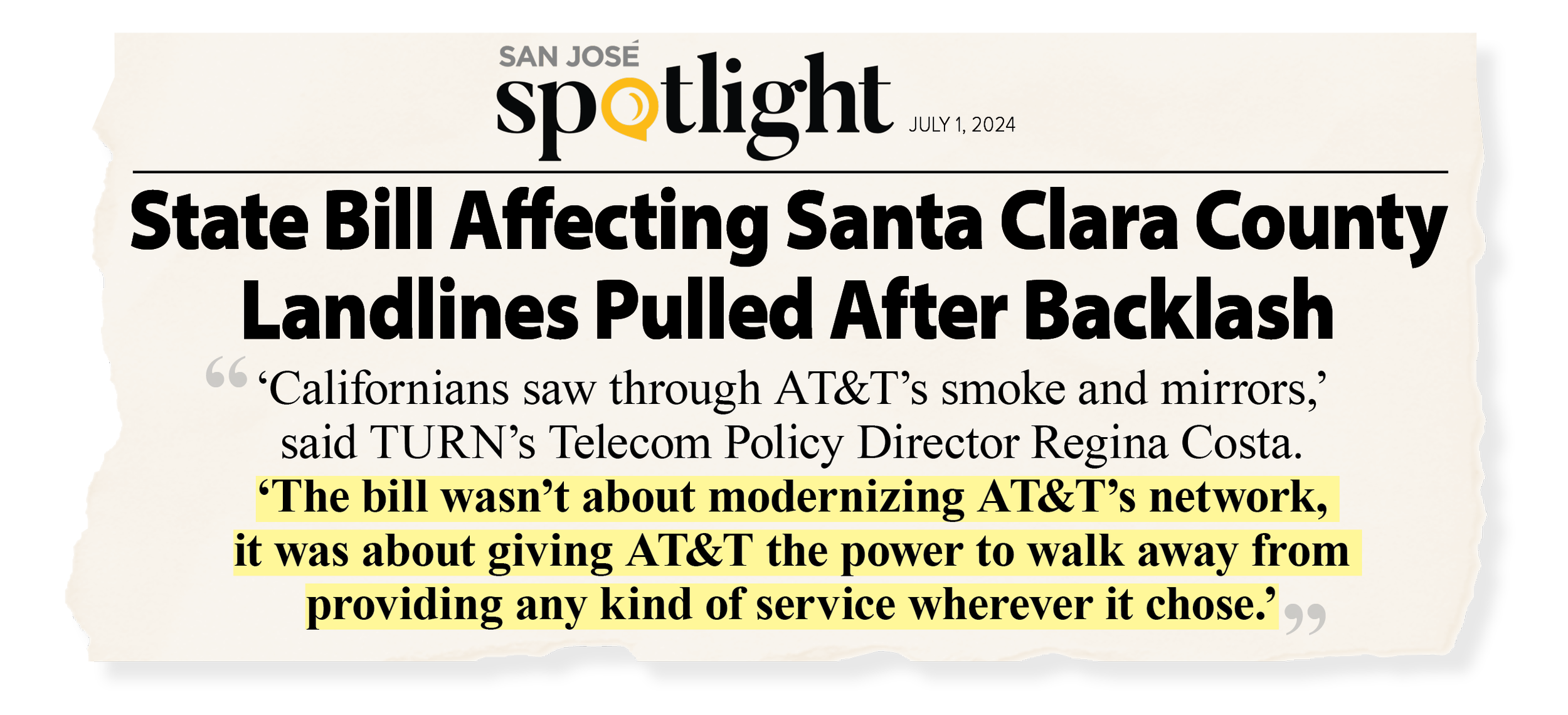
UPDATE: AB 2797 was pulled from the Senate Energy, Utilities and Communications Committee on July, effectively stopping the bill from becoming law. AB 2797 would have allowed AT&T to abandon its responsibility as the carrier of last resort (COLR)—effectively leaving many communities without reliable communications services during emergencies.
Background: No on AB 2797 (McKinnor)! Protect Emergency Phone Communications
Tell the State Senate AB 2797 is up for a July 2 hearing at the Senate Energy, Utilities & Communications Committee.
AT&T has deployed an unsavory “gut and amend” maneuver to transform AB 2797 (McKinnor), originally about horse racing, into a bill that permits AT&T to abandon its obligations to provide landline service, in defiance of today’s CPUC ruling.
AB 2797 would authorize AT&T, or any phone company, to end its COLR obligations simply by sending a letter to the CPUC, self-certifying that alternative voice services are available, stripping the CPUC of its authority to require documentation of viable home and business telephone alternatives, before granting permission to withdraw from COLR obligations.
Thanks to you, and the comments of thousands of California residents, the California Public Utilities Commission (CPUC) voted to dismiss AT&T’s application to withdraw as Carrier of Last Resort (COLR), requiring AT&T to continue to provide landline telephone service to all customers in its territory in California. The CPUC cited public comments and the fact that no other carriers were willing to serve as a Carrier of Last Resort. The CPUC also voted to open up a new policy proceeding to update COLR obligations to provide basic phone service given technological advances.
Public pushback against the AT&T proposal to abandon landline service was overwhelming, with 5,000 residents submitting written comments, and hundreds attending public hearings in Ukiah and Clovis, to share how they depend on reliable landline service to reach emergency responders, social services, neighbors, and family. Many people drove hundreds of miles to speak in person. Others waited on the phone for hours.
Copper landlines remain the most dependable network because they work during power outages, and in rural and coastal communities where cell phone service is unreliable.
Regina Costa, TURN Telecommunications Policy Director, is confident the successful effort to hold AT&T to its obligations as COLR was due in part to “the people of Mendocino County & Humboldt County, people who drove & waited for hours to give public testimony on the problems with AT&T’s proposals. What you did made a massive difference.” TURN fought vigorously against AT&T’s proposal.
“We’re now in fire season and people need a reliable way to receive emergency alerts, and communicate with each other when the power goes out.”
—Regina Costa, TURN Telecommunications Policy Director
Opposition to AB 2797
County Boards of Supervisors
El Dorado County, Humboldt County, Imperial County, Marin County, Mendocino County, Merced County, Monterey County,
Nevada County, San Joaquin County











TURN Newsroom

Source: Capitol Weekly | By Opinion by Mark Toney, Executive Director of TURN
SB 905 would help ensure utilities don’t get overpaid for work that already benefits the company by requiring the California Public Utilities Commission to examine whether the profit margins utilities earn on wildfire-related spending — like undergrounding power lines — are justified. This work already protects utilities from costly wildfire lawsuits, and that protection shouldn’t come with an extra reward: outsized profit margins billed to customers who are struggling to keep the lights on.
Electricity bills have skyrocketed over the past few years for residential and business customers of Pacific Gas & Electric, SoCal Edison and San Diego Gas & Electric — in large part because of the $40 billion customers have paid to cover California’s wildfire costs.
Source: KTVU Fox 2 | By Tom Vacar and Allie Rasmus
Mark Toney, CEO of The Utility Reform Network, known as TURN, a longtime critic of PG&E, was upset. "The legislature adopted nothing," he said. Toney said things TURN wanted were also ignored to keep the California Wildfire Fund able to cover liabilities caused by electric utility equipment. "We need a plan that makes the $40 billon last and doesn't get depleted," he said. "That didn't happen.” TURN's position is that PG&E should live within the money it has and quit the slow, expensive process burying power lines. "At a cost of $4 million a mile and we're gonna replace those with insulating overhead powerlines, insulated poles, at one-fifth of the cost and it can be done much faster," he said.
Pacific Gas and Electric Company announced plans on Wednesday to postpone roughly $2 billion in capital investments next year to bolster its finances, aiming to "reinvent" itself and improve its financial outlook. The reduction in capital spending could impact project timelines for connecting new homes, establishing data centers, and implementing clean energy initiatives.
Source: ABC7 News | By Dryden Quigley
The Utility Reform Network, a consumer advocacy group, said it supports the measure. "We need a way to basically penalize the utility executives for starting wildfires. And that's never happened before," said Lee Trotman with The Utility Reform Network. The organization said it supports the bill in its entirety, arguing that it protects ratepayers while prioritizing wildfire survivors through a faster payout process. "There's no way you can compensate someone for the loss of life, right? Their families, etc.. but you make it financially painful. You make sure that the utility executives have skin in the game," Trotman said.
California lawmakers are a step closer to an agreement on who should be held responsible when a utility causes a wildfire, after the Governor, Senate and Assembly leaders reached a compromise reflected in Senate Bill 492. According to the California Public Utilities Commission, utilities have caused roughly half of the state's most destructive wildfires.
Source: The Sacramento Bee | By Andrew Graham and Stephen Hobbs
Newsom is not alone in his stance, including from people who are not traditionally aligned with utility companies. Mark Toney, executive director of The Utility Reform Network, an organization that works to protect ratepayers from increased electrical rates, backs the idea of eliminating the ability of insurance companies to recoup money. He sees it as a way to help sustain a state wildfire fund and prevent taxpayers from being asked to keep refilling it.
Gov. Gavin Newsom’s last ditch effort to pressure legislators to change the way the state handles utility-caused wildfires involves an array of measures. But one issue in particular has become a flashpoint in the ongoing negotiations: Whether insurance companies should be able to recoup money from a utility company after a fire.
Source: CBS News | By Steve Large
Mark Toney, executive director of The Utility Reform Network, said lawmakers need to move quickly. "We are in a race with time," Toney said. "We need to cut out third parties, insurance companies. We need to limit attorneys' fees.”
California lawmakers and Gov. Gavin Newsom are racing to reach a deal on changes to the state's wildfire liability system, with just days remaining before the legislative session ends. The proposed reforms could affect how wildfire victims are compensated and how much utilities such as PG&E are responsible for paying after fires linked to their equipment.
Source: Benton Institute for Broadband and Society | By Kevin Taglang
During the 2026 proceeding, AARP and TURN argued that the telephone remains a preferred channel for older adults, lower-income households, and consumers with limited digital literacy—and, as TURN noted, for people who do not yet have broadband and are calling to find out what it costs. TURN cited 2023 American Community Survey data showing that "80 percent of adults with vision difficulty own a smartphone, against 62.7 percent with home broadband service."
If you shop for home internet service in the coming months, something on the screen may look different. For the past two years, providers have had to show you a standardized "broadband label"—a black-and-white box modeled on the nutrition panel on a cereal box, listing the monthly price, what happens when the introductory rate expires, the typical speeds, the latency, the data allowance, and each fee added on top. The label had to sit right next to the advertised plan.
Source: The Hemet and San Jancinto Chronicle | By HSJC Newsroom
In a unanimous 4-0 vote Thursday, commissioners rejected the utilities’ plan, saying it failed to provide “sufficient health protections for customers.” The panel had originally set May 1 as the deadline for new rules to take effect. When utilities missed that deadline, consumer advocates filed emergency motions demanding action. By May, with utilities still lagging, The Utility Reform Network joined forces with the San Diego-based Utility Consumers’ Action Network, the National Consumer Law Center and the Center for Accessible Technology to formally ask the commission to step in.
California utility regulators have moved to strengthen protections for customers facing power shutoffs during dangerous heat waves, ruling this week that major electric companies failed to deliver on requirements to better shield vulnerable residents from disconnection when temperatures soar. The decision comes as another punishing heat wave grips much of the state, underscoring the real-world stakes of the debate. In rural areas, losing electricity can also mean losing access to water, since many wells rely on electric pumps. In cities, going without air conditioning or fans during a prolonged hot spell can pose serious health risks, and in extreme cases, prove fatal.
Source: CalMatters | By Alejandro Lazo
By May, with utilities still behind schedule, The Utility Reform Network joined with the San Diego-based Utility Consumers’ Action Network, the National Consumer Law Center and the Center for Accessible Technology,asking the commission to intervene. This week the commission rejected the utilities’ proposal, siding with advocates. The path the utilities were proposing would be “no different” than prior practice. The resolution noted the extreme heat threshold is already below 100 degrees in 41 of California’s 58 counties.
California bars utilities from cutting off power to customers who fall behind on their bills when it’s dangerously hot outside – a basic safety protection. Losing power in some rural areas can also mean losing water, and in cities, having no way to cool down can be dangerous, even deadly, when hot weather spans several days.
Source: Sierra Sun Times | By Gerd Altman
“Extreme heat and utility disconnections are a dangerous combination that can put lives at risk. Today's decision recognizes that access to electricity is essential for health and safety during increasingly frequent heat events,” said Lee Trotman, communications director at The Utility Reform Network (TURN). “By requiring utilities to use CalHeatScore and lowering the temperature threshold for disconnection protections, the CPUC has taken an important step to better protect Californians — especially seniors, families with young children, people with disabilities, and low-income households — from losing power when they need it most.”
The California Public Utilities Commission on Thursday unanimously agreed to reduce the temperature that triggers a statewide ban on utility disconnections to 90 degrees Fahrenheit, rejecting corporate utilities’ proposal to keep the threshold at 100 degrees.
Source: The Energy Show | By Barry Cinnamon
Mark: one of the things we are looking at is 'what’s the energy affordability crisis look like?' About 20% of all customers, five million customers in California are behind on their bills. Another indication is how many families get shut off; in the past year, over 150,000 households had their electricity shut off because they fell behind on their bills. Almost 40,000 were never reconnected. A crisis also looks at what’s happening to small businesses that are shutting their doors because of electricity prices. One of the things that TURN does is we have an alliance with large industries, agriculture, small businesses and other industrial sectors. These businesses get hit double every month so the price of electricity is baked into grocery store prices so everyone feels it over and over again in everything we buy.
Barry: so if you’re wondering why your energy bills are so high, then I suggest you turn to TURN; my guest on this week’s show is Mark Toney, he’s the Executive Director of TURN. I would characterize him as a thinking bulldog when it comes to solving the structural problems of high energy costs. Welcome to the show, Mark!
Source: The Los Angeles Times | By Blanca Begert
“They picked a really high number for their incentives that was out of whack with what they could have earned,” said Matt Freedman, an attorney with the Utility Reform Network consumer advocacy group, who reviewed and provided the authors feedback on the report.
A new report alleges Pacific Gas & Electric inflated costs when it requested a loan for Diablo Canyon, potentially creating a $658.6-million cost to taxpayers if lawmakers don’t intervene. If ratepayer fees for Diablo Canyon were eliminated from 2027-30, experts say, California utility customers could save an estimated $1.84 billion in controversial subsidies.
Source: News from the Office of Steve Padilla |
The legislative package is co-sponsored by ratepayer advocacy group TURN and environmental advocacy group Net-Zero California. “California needs clear, meaningful and ambitious policies to address the rapid growth of data centers,” said Matthew Freedman, Staff Attorney at The Utility Reform Network (TURN). “Senator Padilla’s bills include critical protections to ensure that data center development will benefit the electrical grid, consumers and the environment.”
This week, two key committees in the California State Senate passed Senate Bills 886 and 887, two measures authored by Senator Steve Padilla (D-San Diego) designed to protect California ratepayers from the potential increased costs and environmental damage caused by data centers.
Source: CalMatters | By Sam Uden and Matthew Freedman (TURN Staff)
But with thoughtful planning, data centers can be developed in a manner that actually benefits ratepayers, improves grid reliability and minimizes environmental harms. California should establish clear standards for affordable and clean data center development — and offer it as a model for the rest of the country.
California’s sky-high electricity rates risk making monthly bills unaffordable for families and the state less economically competitive and less of a global hub for technological innovation. Last year, state leaders made progress on reforms aimed at improving energy affordability. But the expansion of energy-intensive data centers to fuel the boom in artificial intelligence is challenging those gains.
Source: Axios | By Shawna Chen
Public power, such as the type SF is seeking, comes with trade-offs, said Mark Toney, executive director of the Oakland-based Utility Reform Network. It can mean more local control and lower costs over time, but it doesn't guarantee better management, he added, pointing to thescandal-plagued Los Angeles Department of Water and Power (the nation's largest municipal utility).
State Sen. Scott Wiener has introduced a bill that could make it easier for San Francisco to break away from PG&E, though major questions remain about cost, timing and potential ripple effects. Frustration with PG&E has been building for years amid rate hikes and outages. Things reached a new boiling point after a December blackout affected roughly one-third of the city, renewing pressure for a publicly run utility in SF.
Source: The Los Angeles Times | By Blanca Begert
Assemblymember Christopher M. Ward (D-San Diego), who in 2022 authored a bill to create a more effective community solar program, said the state needs to double its annual solar installation rate to reach that goal and is not on track to do that using only large utility-scale solar farms and individual rooftop arrays. “We need mid-scale community solar,” he said. He and a coalition of environmental groups, solar developers and the Utility Reform Network, a ratepayer advocacy group, worked to put his 2022 law into effect. They coalesced around requiring utilities to pay community solar developers and customers for the electricity they feed to the grid using the same formula they use for people who install rooftop solar.
Community solar, in which residents get a discount on their bills for subscribing as a group to small solar arrays nearby, was designed to help low-income residents, apartment dwellers, renters and others who can’t put panels on their own roofs. Over the last 11 years, New York, Maine, Minnesota, Massachusetts and other states have built thriving community solar programs. But California has built, at most, only 34 projects since 2015, and experts say that’s a generous accounting.
Source: CalMatters | By Alejandro Lazo
“Data center growth has as much potential to increase electricity rates as it does to decrease rates if not done properly,” said Mark Toney, executive director of The Utility Reform Network.
If you’re worried about data centers and AI inflating your electricity bill, you’re not alone. A California watchdog released a report Tuesday urging policymakers to act fast on the state’s fast-growing data-center industry – before soaring electricity demand from artificial intelligence lands on the bills of ordinary households.
Source: The Sacramento Bee | By George Avalos
The future, however, might bring higher bills, in Toney’s view, primarily because PG&E has a considerable number of proceedings that are pending before its primary regulator, the California Public Utilities Commission. “PG&E still has 13 pending rate requests before the PUC,” Toney said. “We don’t know how long these decreases in bills will last.” As a result, Toney is skeptical that the PUC will prevent bills from rising as it ponders PG&E’s multiple pending requests. “I have a hard time imagining that the PUC’s decisions will result in lower bills when you consider how the PUC typically acts with PG&E rate proceedings,” Toney said.
PG&E electricity bills will be lower this month, the utility revealed Monday, a decline that continues customers’ reprieve from the brutal price spikes of recent years. PG&E cut electric rates further Sunday, on the heels of a reduction that went into effect with the January billing cycle.
Source: CalMatters (TURN) | By Jalal Awan
SB 1221 partly remedies this by requiring zero-emission alternatives only when they’re cheaper than gas, ensuring utilities are made whole, while empowering the commission to shut down gas segments when two-thirds of property owners agree to electrify. SB 1221 offers a rare alignment of climate, affordability and equity. That promise will only be realized if regulators resist the path of least resistance and send neighborhood decarbonization first to the communities that need it most — and where it saves the most money.
But two problems arise. The first is participation bias. The commission’s docket system favors communities with the resources to engage in regulatory processes. The result: a map dominated by coastal, civically organized neighborhoods — leaving higher-burdened, inland and Central Valley communities out. The second problem is utility incentives. Utilities earn guaranteed returns on gas pipelines but face uncertainty with electrification.
Source: The Los Angeles Times | By Alejandro Lazo
Many homes need new wiring, larger breakers or a full panel replacement, and some require upgrades to the service connection to the grid, said Matthew Freedman of the Utility Reform Network. Costs rise quickly when homeowners electrify more than just heating, he said. Customers often underestimate how complex and costly that electrical work can be, he said, another uncertainty on top of the potential for long-term rate savings.
If you’re a California homeowner and you’ve been feeling chilly this winter, there are plenty of reasons to go get a heat pump. An all-electric, energy-efficient alternative to gas-burning furnaces, heat pumps are widely seen as the climate-friendly home heater of choice. They can do double-duty as both home heaters and AC units and are pretty good at maintaining a constant temperature inside a home without the blast-then-cool-off cycle typical of a furnace. What about a guaranteed lower monthly utility bill? Not in California. California has built one of the most aggressive heat pump strategies in the country. The state aims to install 6 million heat pumps in homes by 2030. Lawmakers are also moving this year to boost heat pump adoption — proposing to streamline permitting, and make it easier to electrify homes. On the other hand, California’s residential electricity prices are among the highest in the country — expensive even compared with its also pricey natural gas. That makes heat pumps a tough sell to many Californians. Though the state’s temperate coast is ideal for heat pump adoption, high residential electricity prices can make swapping a gas furnace for a heat pump a pricey proposition. That’s especially true in counties where homes tend to be larger, winters are colder or electricity is costly.
Source: Christopher M. Ward Assemblymember, 78th District | By Anthony Reyes
“Despite the clear directives in AB 2316, the CPUC embraced a non-viable, noncompliant, and incomplete community renewable energy program that was designed to fail and perhaps never even meant to launch,” said Matt Freedman, Staff Attorney, Utility Reform Network (TURN).
Assembly Utilities and Energy Committee Chair Cottie Petrie-Norris (D-Orange) and Assemblymember Chris Ward (D-San Diego) yesterday convened an oversight hearing examining the implementation of Assembly Bill 2316 (Ward), legislation intended to establish a cost-effective community solar program so all Californians, particularly those unable to install rooftop systems, can benefit from distributed clean energy. The hearing was held as part of Speaker Robert Rivas’ newly launched Outcomes Review project, a first-of-its-kind legislative oversight effort focused on ensuring enacted laws are implemented effectively and deliver their intended benefits. “Yesterday’s hearing is accountability in action — and I’m grateful for Assemblymember Chris Ward’s steadfast leadership on oversight and transparency,” said Assembly Speaker Robert Rivas. “I authored AB 2316 because a successful community solar and storage program has incredible potential to reduce rates across the board, reduce net peak demand, avoid long-term transmission investment, and displace expensive gas generation,” said Assemblymember Christopher Ward. “However, I am extremely frustrated with the CPUCs rejection of its legislative intent, and instead adopted a wholly unviable program. My hope is that I can work with the CPUC, along with my colleagues in the legislature, to find an appropriate path forward that achieves the goal of the original bill.” During the hearing, committee members raised concerns about the lack of a viable community solar program more than three years after AB 2316’s passage, including why the California Public Utilities Commission rejected a widely supported Net Value Billing Tariff backed by industry, labor, environmental organizations, and ratepayer advocates in favor of a proposal submitted after the deadline.
Press Releases

SAN FRANCISCO— The California Public Utilities Commission today agreed to reduce the temperature that triggers a statewide ban on utility disconnections to 90 degrees Fahrenheit, rejecting corporate utilities’ proposal to keep the threshold at 100 degrees.
Oakland, CA - Today, The Utility Reform Network (TURN) has filed a motion to intervene in AT&T’s federal lawsuit against the California Public Utilities Commission and California Attorney General. TURN submitted this filing in partnership with the California State Association of Counties (CSAC), Rural County Representatives of California (RCRC), and the Communications Workers of America (CWA).
SACRAMENTO – Yesterday, Senator Steve Padilla (D-San Diego) introduced Senate Bills 886and 887, two measures designed to protect California ratepayers from the potential increased costs and environmental damage caused by data centers.
Oakland, CA — The Utility Reform Network (TURN) is calling on PG&E customers to raise their voices against PG&E’s proposed rate increases, which could drive monthly bills up by $42—totaling more than $500 annually—by 2030…
Coalition applauds Senate’s SB 254 release; calls for swift passage alongside CAP’s affordability measures for both immediate relief and long‑term savings…
Los Angeles, CA — Southern California Edison (SCE) reported a record $1.619 billion in 2024 profits today, a 9.8% increase from the previous year. While profits increased, SCE customer’s rates have increased by 26% in the last three years…
San Diego, CA — San Diego Gas & Electric today reported near record profits of $891 million off the backs of customers. SDG&E’s earnings report follows over $1.6 million spent in 2024 by its parent company…
SAN FRANCISCO — Pacific Gas & Electric (PG&E) today reported a 10% increase in profits from 2023 to 2024, totaling $2.48 billion dollars.
Sacramento, Calif. — California’s four major investor-owned utilities (IOUs) — for-profit corporate utilities — spent a staggering $21,854,420 on lobbying and influence efforts in 2024.
Sacramento, CA — The Utility Reform Network (TURN) released their 2024 Legislative Affordability and Accountability Scorecard today, evaluating lawmakers’ commitment to utility affordability and accountability during the 2024 legislative session.
SACRAMENTO, Calif. — California voters want policy leaders to take decisive action to address the root causes of high electricity bills, including limiting how much utilities can spend and profit, according to a poll conducted by David Binder Research...
On May 10, the California Public Utilities Commission (CPUC) issued a proposed decision to dismiss AT&T’s application to withdraw as Carrier of Last Resort (COLR), requiring AT&T to continue to provide landline telephone service to all customers in its territory in California…
On February 1, the California Public Utilities Commission issued a proposed decision to authorize early collection of $516 million from PG&E customers for wildfire safety, and other infrastructure upgrades, conducted in 2022…
Today, Senator Dave Min (D-Irvine) introduced Senate Bill (SB) 938, which will prohibit political lobbying by investor-owned utilities that can be charged to ratepayers. While federal law technically prohibits utilities from passing lobbying costs onto their ratepayers…
When you think about what you’re paying for in your electric and gas utility bill, you probably think of the energy powering your lights, furnace, and stove…
On December 1, PG&E submitted a CPUC filing requesting its customers to pay an additional $2 billion in rate increases to cover wildfire mitigations costs, barely two weeks after approval of record breaking increases for its General Rate Increase.
On November 7, PG&E executives scheduled a private meeting met with Commission staff to lobby for an additional $1.8 billion in ratepayer increases in the Alternative Proposed Decision, which had already been modified in PG&E’s favor.
Yesterday, the California Public Utilities Commission (CPUC) voted unanimously to consider proposals to improve service quality requirements for telephone service, and expand service quality requirements to cover Voice over Internet Protocol (VoIP) phone…
Yesterday, the California Public Utilities Commission (CPUC) unanimously approved a grant program to help local agencies develop local public broadband networks. Soon, local agencies and Tribal governments will be able to apply for grant funds to…
Securitization—Just another word for a Bailout
TURN files in Court to reverse risky CPUC $11 billion PG&E Bailout
The Utility Reform Network filed a challenge in the State Court of Appeals on September 10 to reverse the May 6 California Public…